Monday, November 23, 2015

Middle School Reading Professional Development

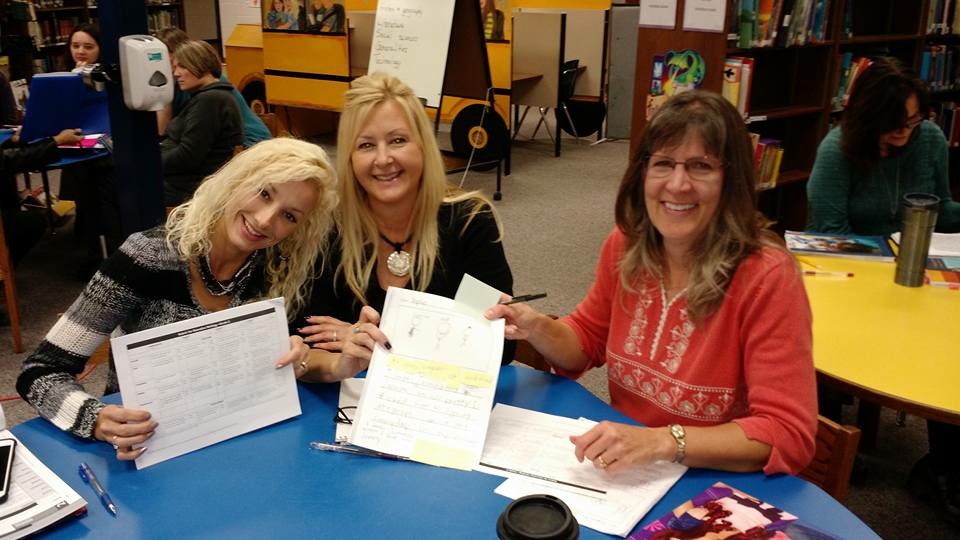
This past week, the Middle School ELA team and I were tasked with providing some professional development around the area of reading.  We attended a work shop on Adolescent Readers at CESA #9, led by Casey Gretzinger.  It was great for the four of us to attend some professional learning together and then have time to process how to share this information with staff.


Our middle school schedule allows for common planning time 1st hour.  This week we met as a school and began the professional development at this time, to be further carried out after school during the staff meeting.

We began by having the staff think about these three questions:
  1. What types of texts do you ask kids to read?
  2. What do you know about close reading?
  3. In what ways do you accommodate struggling readers in your class?
Staff wrote their answers on post-its and placed them on the chart paper. 


Then we passed out the following paragraph.  We gave no background information and asked staff to read it and tell us what it was about.


The procedure is actually quite simple.  First your arrange things into different group.  Of course one pile may be sufficient depending on how much there is to do.  If you have to go somewhere else due to the lack of facilities, that is the next step; otherwise you are pretty well set.  It is important not to overdo things.  That is, it is better to do too few things at once than too many.  In the short run this may not seem important but complications can easily arise.  A mistake can be expensive as well.  At first the whole procedure will seem complicated.  soon however, it will become just another facet of life.  It is difficult to foresee any end to the necessity of this task in the immediate future, but then one can never tell.  After procedure is completed one arranges the materials into different groups again.  Then they can be put into their appropriate places.  Eventually they will be used once more and the whole cycle will then have to be repeated.  However, that is a part of life.  (Brandsford and McCarrell 1974)


After, we had staff share how this experience made them feel.  Here are some of the responses:
  • "I gave up, because I didn't get it."
  • "I kept reading and rereading hoping to find the right answer, because I had to get it right."
  • "I was very nervous that you were going to call on me to tell what it was about, and I was afraid I would get it wrong."
These are responses we would expect to hear from our students!  Then we asked them what would have helped them understand it, and to imagine how this makes their students feel.

We shared this quote from Reading Nonfiction: Notice & Note by Kylene Beers & Robert E. Probst to close our sharing:

When we use lecture and explanation as our primary way of sharing information in the classroom, we imply that someone else knows, and all students have to do is listen.  This disenfranchises them and leaves them vulnerable...They will have little practice learning how to learn.

For our afternoon staff meeting we asked staff to think about a piece of text they were going to having their students read in class within the next two weeks.  They were to bring this to the after school  meeting to make a plan on how to help their students understand the text.

I will post more on this in my next post.


Thursday, November 5, 2015

Post Conference

Modeling, observation and feedback are essential elements for learning and we see this with our students.  This is why this process also works for teachers. Many teachers who have been a part of Jim Knight's work in Topeka comment that coaches who modeled have helped them "teach with fidelity to research-based practices, increased their confidence about new practices, made it easier to implement new practices, and provided an opportunity for them to learn other teaching practices," (2007, Instructional Coaching).


Last week I modeled in the 4th grade classroom for four days, while the three 4th grade teachers observed.  They wanted to see what introducing literature discussion groups looked like. I tweaked a unit I had used as a classroom teacher, based on what I had learned about best practice in literature discussion groups.  I blogged a bit about it in this post.

Post-conferencing is a crucial part of the modeling/coaching process and it is necessary to schedule this.  If I do not set this time aside, I find I rarely get back to those teachers to reflect on the learning that took place.  It is also a time for me to learn from the teachers whom I am working with.  I expect to hear things they liked, didn't like or things that were unclear.  

During our monthly common planning time, I asked the fourth grade team to reflect on the modeling and learning that took place.  I use this form to guide me.  I got this form off of Jim Knight's website and I found it applied perfectly to this situation.

From our discussion the teachers noted that:

  •  It was great to see their students being taught by another teacher.
  • They liked that they could get in and listen to their students as they were pair-sharing during the guided practice portion of the lesson.
  • The realized they need more student led discussions; less teacher talk.
  • They liked that their students could see videos of other literature discussion groups in action as a model prior to being asked to do it themselves.
It was great to get our post conference in and then to further our learning, as question on types of text, choice, and time were brought up. This was my first experience modeling for an entire grade level and it was a great experience. I am fortunate to work with a great team of teachers who are excited about learning and willing to take risks and try new things.


Thursday, October 29, 2015

Norming On-Demand Writing Assessments

Our monthly staff meeting around Lucy Calkins started with a celebration.  One of our third grade teachers was very excited about the work her students had done on leads.  They revised leads thinking about setting, dialogue and actions.  This was much improved over the writing we saw from the beginning of the year.


Next, we decided to spend our time norming their narrative on-demand assessments they gave the first month of school.  The reading team copied off the rubrics and then asked the teachers for 2 pieces of writing each for below, on, and above grade level. We took off the names and made copies for all involved.

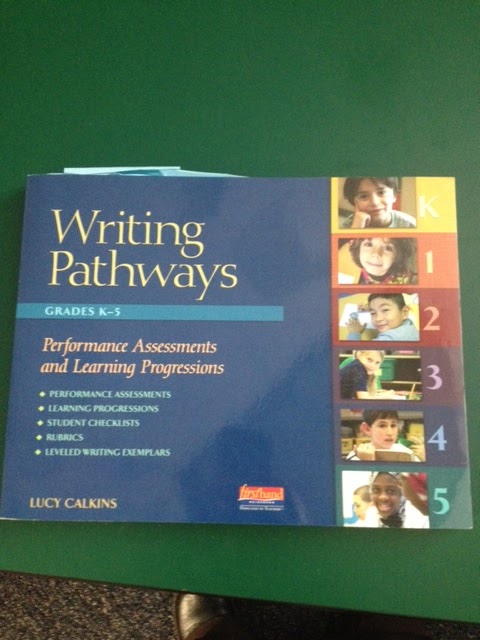
We began the meeting by talking about the importance of norming.  I used the information in the Writing Pathways book from Units of Study for Writing to guide our discussion.


  • Why we norm: The purpose of a norming meeting is to establish consistent and shared expectations across the school for student writing.  We align our group as we engage ourselves in close, evidence-based reading.
  • What is the process: Four steps below
  • What happens when we disagree: Expect and embrace conflict.  Conflict is evidence that there is disconnect in the way your view student work, and digging into that disconnect will help you to align your vision.
    • If some consensus is not possible, a half-point is an acceptable difference of opinion.  Generally if 10 minutes of discussion doesn’t yield something close to consensus, the piece is set aside as a “fence sitter.”  Don’t let that one piece derail the whole activity.

Questions to consider:
Work as a group to score 1 student’s piece of writing to reach consensus – where does the student fall?
Where does the student fall on the learning progression and in relation to grade level?


Steps in a Norming Meeting:
Step 1.Work as a group to score 1 students piece of writing to reach consensus – where does the student fall?
  • Read through the piece one time
  • Then inch through the rubric to assess each item, be careful to note which traits have double the points

Step 2:Score a few other students, then everyone score individually, and come together: What score did we give them?
  • If after doing this work with 5 papers of different levels, the group finds that it can come to a consensus, the group can consider itself normed and people can now score papers individually

Step 3: Assess your own students’ writing individually

Step 4: Devise a plan for analyzing on-demand writing across each grade
  • will you just look at a few above, at and below
  • maybe you will decide just to focus on a few traits that are especially important in the upcoming unit
  • maybe you will decide that this scoring process is so valuable that you will continue this work with every on-demand assessment

When making assessment decisions, we need to ask: What are you actually trying to get out of this?

The Payoff:  A school culture in which learning progressions, benchmark pieces, and rubrics help teachers work with each other and with their students to accelerate progress.


We definitely needed more than the 40 minute staff meeting to complete the norming process, as we really only got through step 1.  However, this is the first time our staff has been asked to complete this type of work and it was great to hear the conversations around writing occuring.


Tuesday, October 27, 2015

Literacy Leader Networking


I have had the pleasure to attend a few literacy leader networking sessions over the past two weeks and I am really excited to share what I have learned.
The first session I went to was a literacy and math leader networking day put on by CESA #9, and led  by Casey Gretzinger and Linda Myers.  We began the day by grounding ourselves in our beliefs about what coaches/leaders do.  This began by using a survey to individually assess our beliefs, then discussed in our group, determined our individual top 5, then wrote on chart paper our common table beliefs about coaching.  This was a great discussion to ground our district coaching beliefs, which we found were very similar.  We continued to network about best practices and engage in some individualized learning during the afternoon.


Friday, I attended DPI’s Literacy Coaches Network  hosted by Barb Novak, Laura Adams and Marci Glaus. It is one of my favorite days of the year, as these ladies never disappoint in their presentation or in their enthusiasm.  We began the day with a coaching session presented by Laura Gleisner.  Laura is a coach certified by the International Coaching Federation.  She guided us through assessing our Emotional Resilience. The categories we assessed ourselves were: sleep, optimism/positive thinking, renewal experiences, support network, nutrition, exercise, communication, internal locus of control.We then used the coaching wheel to see how smooth or bumpy our road is.  


From there Laura shared with us the Dreaded Drama Triangle that we all may get drawn into during our coaching conversations as we become the rescuer.
Victim Mentality
·        It’s not my fault
·        Things are being done to me
·        I am powerless
·        There is nothing I can do

*We have to be careful so that we do not get sucked into the dreaded drama triangle (Dr. Stephan Karpman)-victim, persecutor, rescuer


The antidote to the Dreaded Drama Triangle is the Creator Orientation developed by The Power of Ted by David Emerald.


The third piece of the triangle is the Coach.  We must believe that EVERY person is creative, resourceful and whole.  We can coach someone through the Creator Orientation.  Our steps include:
·         Empathize
·         Ask what the client wants instead
·         Build awareness around their own behaviors
·         Help client work within their lotus of control
·         Capitalize on strengths
·         Help see persecutor as a learning opportunity
·         Commit to taking action

After lunch, we moved into reflecting on and discussing our culturally responsive practices.  Here is what the Wisconsin's RtI Center has developed.
Using the above chart (link), we had to reflect on what our values were growing up, what they are now, how are schools operate, how my students/families might be different, and how this difference creates conflict.  This was a great activity to bring cultural differences to the forefront of our minds.

I am so fortunate to have been invited and allowed by my district to attend these two wonderful networking opportunities.  


Tuesday, October 20, 2015

Guided Reading in Grades 3-5

This week's common planning meetings centered around the topic of guided reading.  I met with grades three, four and five. Our discussion focused on transitional guided reading, fluent guided reading and literature discussion groups.

Two books that have helped me tremendously in the area of guided reading and literature discussion are the following:


I have seen all of the author's speak as well, and have crafted my small group instruction based on their philosophies.

One big misconception that needed to get out in the open was the idea of using round robin reading.  When students are involved in this type of reading, only one student is doing the work-the one reading aloud.  We have such precious little time to work in small groups with students that we have to have them working the whole time.  Students all need to be reading the text silently to themselves as the teacher listens in to each one individually at whichever point they are in the text.  Another reason this is important is the students should be hearing only the very best reader in the room read aloud...and that person is the teacher.  

Transitional Guided Reading
Levels J-P
Instructional Needs: self-monitoring, decoding, fluency, vocabulary and retell
Framework for Guided Reading
·         Selecting the Text
·         Introducing the Text
·         Reading the Text
·         Discussing and Revisiting the Text
·         Teaching for Processing Strategies
·         Extending the Meaning of the Text (optional)
·         Word Work (optional)


Fluent Guided Reading
Read Fluently above a level N, with no decoding, fluency or retell issues.
Select a focus strategy.
Materials: any relatively short text can be used-poetry, short stories, newspaper articles, magazine articles, short chapter books and informational books.
 (it is recommended not to use a novel for guided reading-these are better for literature discussion groups or self-selected reading)

From our discussions we discovered the following:
3rd grade: 2-3 guided reading groups
4th grade: 2 guided reading groups
5th grade: 1 guided reading group

The majority of students in 5th grade were able to read fluently and benefit more from rich discussions with their peers around similar texts as occurs during literature discussion groups.

Literature Discussion Groups
Small-group conversations about books.
7 predictable, yet flexible components:
  1. Introduction and Selection of book
  2. Silent Reading
  3. Teacher Conference
  4. Group Discussion w/teacher present
  5. Peer Discussion, extension of the group with only students
  6. Text Mapping and Focus groups
  7. Literature Extensions, variety of activities

This week I am modeling how to introduce literature discussion groups with our 4th grade team. Our principal graciously offered to instruct the students who are not quite ready for this, so that our whole team can watch the teaching.  I began yesterday and look forward to model the future lessons all this week.


Monday, September 28, 2015

Staff Meeting with a Twist

Our principal has requested two staff meetings a month.  The first staff meeting usually revolves around housekeeping and general information.  The second staff meeting revolves around our implementation of Lucy Calkins Units of Study in Writing.

This is the first time in a long time that our staff has been involved in this type of professional development.  The reading team built this session around our first session that we held during common planning time.  It was a bit tricky, as we had all 4K-5 staff involved.

The session began by asking the teachers to reflect and discuss with their teams things they had tried in their classroom based on our last meeting.  It is important for teachers to understand that there is going to be follow-through with the learning and that there are literacy coaches there to support them. When professional development merely describes a skill to teachers, only 10 percent can transfer it to their practice; however, when teachers are coached through the awkward phase of implementation, 95 percent can transfer the skill (Bush, 1984; Truesdale, 2003) - See more at: http://www.centerforpubliceducation.org/teachingtheteachers#sthash.lOcmsqXT.dpuf.  The literacy coaches circled around the groups and listened in.  I took notes on key points that the grade levels I work with brought forth.


Then we watched a mini-lesson.  It is crucial for the staff to continue to see what best practices in the area of literacy looks and sounds like.  The video was chosen due to it's wide range of ages it could correspond to and also due to it's area of focus on personal narratives, which every grade level has been immersed in since the beginning of the year.

Link to Video: https://www.youtube.com/watch?v=g8nf1OHUIe0


After the video, teams were again encouraged to discuss what they noticed, what they further need, and what they are going to try.  Exit slips were also turned in.  These were given to each table to synthesize their learning.


Wednesday, September 9, 2015

The Workshop Model

The literacy team held our first coaching meetings with our grade level teams today.  We were all a little nervous about how it would go.  I had to remind myself that I looked forward to my literacy coach meeting with my team when I was a classroom teacher, as I always walked away with some new insight.  I also had to remind myself that in-house professional development is meaningful to teachers.  The following link has some great research to support this: http://www.centerforpubliceducation.org/teachingtheteachers.  Some main points were that teachers can learn, but struggle with the implementation; professional development should occur over time and be ongoing; and professional development is best when it is offered in the context of the teacher's content.

Our team decided that the workshop model would be our first topic for the meetings, and from there the topics would be driven by the teams.

I started by using an Affinity Diagram with  my teachers.  I needed to know their background knowledge on the workshop model and I thought it was important for them to also hear from each other.  I had them write a word or a phrase on post-its that came to mind when they heard the phrase "Workshop Model."   From here, they put their post-its up on chart paper and started to look for patterns.  They discussed how certain post-its went together and why and then determined a word to categorize the post-its.  Here is what one of my teams came up with...

Their initial categories were: mini-lesson, work time, differentiation, summary/closure.

From here we watched the fabulous Mr. Minor demonstrate a mini-lesson on creating setting for fantasy writing (https://vimeo.com/55966103).  The teachers wrote down what they noticed about the lesson and then we shared out.  There are some misconceptions that I will need to clear up in one-on-one situations, but overall I was pleased with how the discussion went.

Lastly, we discussed the critical elements of the workshop model, and I stressed that this can happen in any content.  
  • tight focused mini-lesson, with direct modeling, "This is my turn to show you"
  • guided practice
  • independent work time (Daily 5, guided reading, conferencing, strategy focus groups, literature discussion groups, etc)
  • Share time (purposes: share what you did during independent practice, how did we manage, teaching/pushing them even further)
We finished the meeting by sharing what each teacher planned to do with the knowledge gained and what our plan would be for next time.
​


·